Old LEGO® Sets: Identify Them and What They're Worth
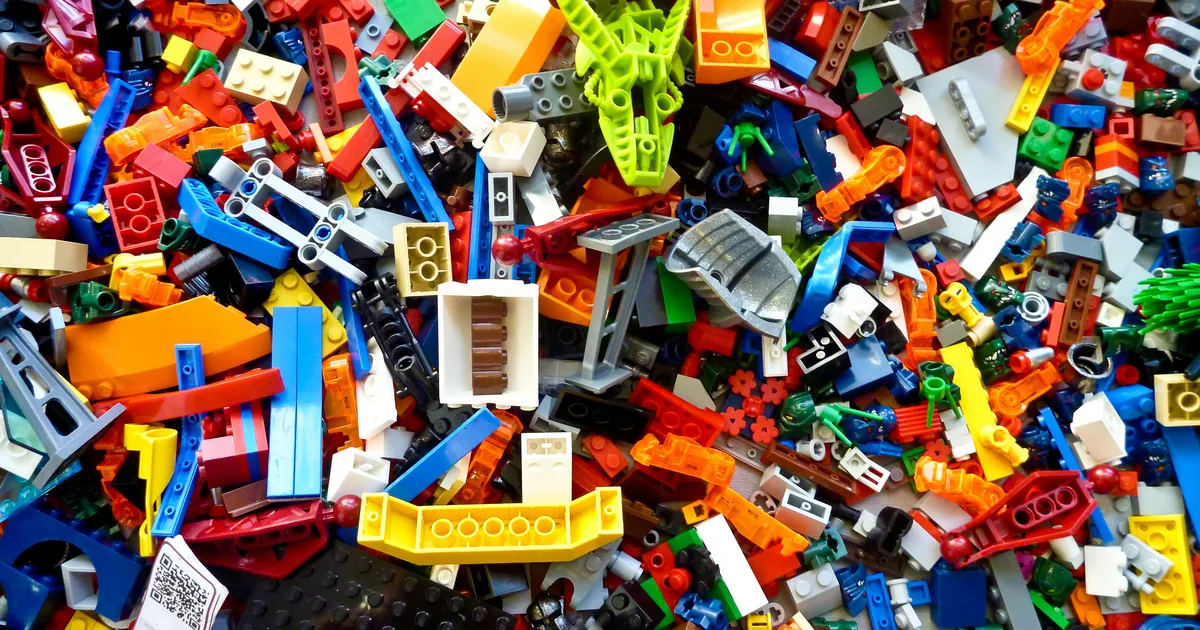
Old LEGO sets turn up in lofts, under beds and at the back of wardrobes more often than you'd think, usually as a tub of loose bricks with no box and no instructions. The first job is not valuing them. It's working out what they actually are.
Once you know which sets you have, whether they're complete, and roughly how old they are, the value question answers itself.
I found this out properly when my own family started sorting through what the kids had left behind. We assumed we knew what was in there. We didn't, not really. More on that below.
Why old LEGO sets are hard to identify
A new set comes with a box, a set number printed on the side, and instructions that tell you exactly what you're holding. An old set, separated from its box years ago and tipped into a tub with eight others, has none of that.
You're left with a pile of bricks and a guess.
The pieces themselves can help, if you know what to look for. Colours changed over time.
LEGO's bluish greys, Light Bluish Gray and Dark Bluish Gray, replaced the earlier light and dark greys in a changeover that's commonly dated to the early 2000s. If a piece looks like an old grey rather than today's bluish grey, that's a rough clue to the set's age.
I've written more about telling the two greys apart, because under a kitchen light they're genuinely difficult to call.
Printed pieces, stickers and certain element shapes also date a set, but reading all that correctly takes a fair bit of knowledge most people don't have and don't need. The practical route is simpler: match what you physically have against a database of what was actually in each set, and let the matching do the dating for you.
Sort by colour if that's your instinct, then allocate
If the pile has more than one old set tipped into it, which is the usual case, sorting by colour first is a perfectly good starting point. It's not the mistake.
The mistake, and I made it myself, is stopping there. A few hours into my own tub I had neat colour piles and not one finished set, because colour sorting on its own doesn't put anything back into a set. It just tidies the mess.
What actually finishes the job is allocating each colour group back to the sets it belongs to, using anything distinctive, a printed piece, a minifigure, an unusual shape, to anchor each group as you go.
I've covered the method properly in how to sort loose LEGO bricks the fast way, and the short version is: sort by colour if you like, then allocate.
Once sets are separated out and mostly complete, keeping them that way matters too. I've written about how to store LEGO sets so you can find any one fast, which is worth doing before everything ends up back in one tub.
Check what you've got is actually complete
An old set that's missing a dozen pieces is a different proposition from one that's complete. It's worth building before you decide anything about keeping or selling it, because a gap in the middle of a build is far more annoying than a gap you knew about from the start.
If you're buying an old set secondhand rather than finding one in a loft, the same logic applies before money changes hands, not after. The listing is always going to say complete. It's worth checking anyway, because nobody really knows until the pieces are actually counted.
I've written about how to check a used LEGO set is complete before you buy, and it's worth five minutes against any listing that matters to you.
If pieces are missing, the sensible order is to work out exactly which ones first, then buy in one batch rather than ordering bit by bit as you notice gaps. I go into why in the piece on LEGO missing pieces.
Old LEGO sets and value: what's actually true
Here's where I'll be honest rather than exciting. Most old LEGO sets are not rare and not especially valuable.
From what I've seen, the ones that hold real money tend to be licensed sets that are no longer produced, or sets that sold in smaller numbers than you'd expect. I wouldn't call that a rule, just a pattern.
A study by Victoria Dobrynskaya and Julia Kishilova, covering over two thousand LEGO sets, found secondary market prices for retired sets grew by an average of 10 to 11 per cent a year between 1987 and 2015, outperforming stocks, bonds and gold over that period, as reported by HSE University.
That's a genuine finding and it's genuinely old data too. It describes an average across a large sample over nearly thirty years, not a promise about any particular set you happen to own, and not a figure to treat as current year advice.
What I can tell you from my own experience is that value is rarely where you expect it. When we eventually worked out what was in our own pile, one of the most valuable sets turned out to be a small Toy Story set, 7598 Pizza Planet Truck Rescue, that none of us thought twice about.
We didn't even know we still had it until it came out of the tub. It was only once we'd identified it properly that we found it was worth over £100. The big, obviously impressive sets weren't where the money was.
That's the actual argument for identifying old sets properly before you decide what to do with them. You cannot know what something is worth until you know what it is, complete or not.
I'll give you the honest limit here too. Knowing a set's current market value, checking sold listings, deciding whether now is the right time to sell, none of that is something Gybio does.
That's a job for BrickLink, BrickEconomy or a specialist reseller. What identifying your old sets gives you is the information those tools need: the set number, and whether it's actually complete.
My post on retired LEGO sets goes further into what "retired" actually means and how it affects value.
Where classic and vintage LEGO sets fit in
"Vintage" gets used loosely in the LEGO world. There's no official cutoff, and fans use it to mean different things, usually just old enough that nobody kept the box.
Rebrickable and Brickset both catalogue sets going back decades, and either is worth a browse if you want to see what a set actually looked like new before deciding whether what's in your tub matches it.
Classic sets from the 90s in particular are a common find in family lofts, because that's when a lot of today's adults were children, and a lot of their sets never made it back into the box afterwards. If that describes your pile, the same identify-then-sort approach applies regardless of decade.
Where Gybio actually helps, and where it doesn't
Gybio will take a photograph of a piece you can't place and tell you which of your own logged sets it belongs to, using the Brickognize API for recognition and Rebrickable for set data. You can try it at app.gybio.co.uk.
Load your old sets in, and it'll also show you what each one still needs, so you can see at a glance how close you are to complete.
What it won't do: verify a seller's claim for you, or guarantee a match on every single old or obscure set. It will show an estimated second-hand value for a set you've logged, but that's an estimate from BrickEconomy's market data, not an appraisal of your particular copy in its particular condition.
Recognition depends on the part being in Brickognize's catalogue and the set being in Rebrickable's, and my guess is very old or obscure sets are thinner in both than current ones, though I haven't got hard figures to back that up. On a clear photo of a common piece it's good. On a worn, decades-old piece photographed in bad light, it's guessing, the same as you would be.
That's a smaller claim than the one on most app pages. It has the advantage of being true.
FAQ
How can I tell how old a LEGO set is?
Look at the colours and piece styles first, older greys, certain printed pieces and element shapes all date to particular eras, but the reliable way is matching what you have against a set database like Rebrickable or Brickset, which record exactly what came in each set and when.
Are old LEGO sets worth more than new ones?
Not automatically. Value depends on the specific set rather than its age, and plenty of old sets are worth less than people assume. The ones that hold real value tend to be licensed sets no longer produced or sets that sold in smaller numbers. Checking what you actually have, complete or not, matters more than assuming age equals value.
What's the difference between a retired set and a vintage set?
Retired just means LEGO has stopped producing it, which can happen to a set from last year. Vintage is a looser, fan-used term usually meaning older sets. A set can be retired without being vintage, and most vintage sets are retired by definition.
Can I find out what old LEGO set I have from loose pieces alone?
Often, yes, especially if there's a distinctive piece, a minifigure or a printed part in the mix to anchor the search. A plain, common brick on its own won't narrow much down. An app that checks a piece against set inventories, like Gybio, is built for exactly this gap.
Should I sell old LEGO sets or keep them?
That's a personal call, but it's one you can only make properly once you know whether the set is complete and roughly what it might be worth. A complete set is worth more and easier to sell than a loose pile, and some people keep sets specifically so a set can be rebuilt again by someone else down the line.
Old LEGO sets are rarely as straightforward as a quick glance suggests. The pile on the shelf is usually worth more time than it gets, not because every set is valuable, but because you genuinely don't know until you've looked properly.